
 English


Views: 0 Author: Site Editor Publish Time: 2026-09-23 Origin: Site


Scaling fiberglass reinforced plastic (FRP) manufacturing presents a significant challenge for modern engineering teams. Moving from initial low-volume prototypes to scaled production forces a critical financial decision. You must carefully balance immediate capital expenditure against long-term operational costs. Procurement teams and project managers often struggle to time this transition correctly. They frequently over-invest in highly expensive steel tooling before finalizing their designs. Conversely, they bleed profit margins by relying on variable manual processes for far too long. Choosing the wrong manufacturing method directly compromises part quality. It also routinely destroys carefully planned project budgets. This article provides a clear, metric-driven framework to help you evaluate your production options effectively. We will explore specific volume thresholds, mechanical performance criteria, and strict industry compliance requirements. You will learn exactly how to approach this manufacturing pivot to maximize profitability and ensure structural integrity.
Understanding the fundamental mechanics of each production method is your first step. Each process carries unique operational realities. These realities dictate how quickly you can produce parts and how consistently those parts will perform in the field.
Hand lay-up represents the most traditional form of composite manufacturing. This open molding technique relies heavily on manual lamination. Technicians manually place fiberglass mats onto a single-sided mold. They then apply catalyzed liquid resin over the fibers. These low-cost molds typically consist of wood, machined foam, or basic composite materials.
The system cures at room temperature. Therefore, the process depends highly on ambient conditions. Fluctuating factory humidity and temperature can drastically alter curing times. More importantly, success relies entirely on technician skill. Operators must manually roll out trapped air bubbles. They must ensure even resin distribution across complex geometries.
This introduces a severe risk factor. Inconsistent resin distribution directly leads to varying part weights. It often creates hidden weak spots inside the composite matrix. You face a higher probability of structural failure if operators rush the lamination process.
Closed molding completely changes the production environment. This automated process utilizes heated, matched metal tooling. Manufacturers typically machine these molds from hardened steel. Technicians mount these heavy tools inside a high-tonnage hydraulic press.
Instead of liquid resin and loose mats, the process uses pre-measured compounds. You typically feed Sheet Molding Compound (SMC) or Bulk Molding Compound (BMC) into the open mold. The hydraulic press closes. It applies immense heat and pressure to the compound. The material flows rapidly to fill every cavity of the mold.
The primary advantage is speed. Cycle times drop drastically. A part taking four hours to cure in open molding might cure in four minutes here. This establishes highly predictable production schedules. It removes ambient weather conditions from your operational equation.
When evaluating compression molding vs hand lay up directly, the core operational shift becomes obvious. You are moving from a labor-intensive, variable process to a capital-intensive, highly controlled process. Open molding requires cheap tools but expensive, ongoing human labor. Closed molding demands a massive upfront investment. However, it delivers incredibly cheap, lightning-fast cycles once production begins.
Financial modeling drives the transition between these manufacturing methods. Engineers must justify the leap to automated production using hard data. You need to calculate exact breakeven points to protect corporate margins.
Capital expenditure varies wildly between the two methods. Hand lay-up molds remain incredibly cheap. You can build a viable production mold for a few hundred to a few thousand dollars. You can also modify these molds easily using basic shop tools.
Compression molds require intense capital investment. These matched metal tools demand precision CNC machining. Engineers must design complex thermal channels inside the steel to ensure even heating. The steel requires specialized hardening treatments to survive high-pressure cycles. Consequently, tooling costs range from tens to hundreds of thousands of dollars. This initial sticker shock often deters procurement teams.
You must contrast the tooling costs against operational expenses. Hand lay-up incurs massive ongoing labor costs. Every single part requires human intervention for lamination, rolling, and demolding. Furthermore, open molding generates significant material waste. Technicians must aggressively trim and finish the raw edges post-cure. Sanding and painting add additional hours to the per-unit cost.
Automated molding minimizes this manual intervention. The press does the heavy lifting. Flash removal requires seconds rather than hours. This efficiency drastically lowers the recurring per-unit cost. Material waste approaches zero because you weigh the SMC precisely before placing it into the tool.
You must calculate the volume threshold to make an informed decision. This threshold occurs where the amortized cost of the steel tool dips below the accumulated labor and scrap costs of manual lay-up. Follow these steps to map your breakeven point:
The resulting number tells you exactly how many parts you must produce to justify the metal tool. Production beyond this specific number generates pure profit margin compared to open molding.
Do not rely purely on basic labor rates. You must evaluate the hidden cost of quality. Manual lay-up historically suffers from higher scrap rates. Human error leads to dry spots and excessive voids. You must account for rework labor. Calculate the potential cost of warranty claims caused by field failures. These hidden costs often push the breakeven point much earlier in the production lifecycle than basic estimates suggest.
Cost is only one half of the equation. Mechanical performance often forces engineers to abandon open molding regardless of volume. Stringent industry standards require precise material properties.
The strength of any composite part depends on its fiber-to-resin ratio. We call this the Fiber Volume Fraction (FVF). Hand lay-up struggles to achieve high fiber density. The process typically maxes out at a 30–40% fiber content. Technicians simply cannot apply enough manual pressure to squeeze out excess resin.
Closed molding routinely achieves a 50–60% fiber content. The hydraulic press forces the resin deep into the fiber matrix while expelling excess material. This density significantly increases both tensile and flexural strength. Parts become much lighter while carrying heavier dynamic loads.
Tolerances matter deeply during final assembly. Hand lay-up yields only one "A-side." This is the smooth side contacting the mold. The "B-side" remains rough, fibrous, and dimensionally unpredictable. If you need tight tolerances on the B-side, you must pay for extensive secondary machining.
Matched metal tooling produces A-sides on all tool-contact surfaces. The dimensions remain completely locked. You achieve tolerances tight enough for direct assembly. The parts support immediate gasket seating and seamless automated integration on your assembly line.
Trapped air creates voids inside the composite matrix. Hand rolling rarely removes all microscopic air pockets. These voids act as stress concentrators. They weaken the part under heavy impacts.
High tonnage forces out virtually all trapped air. Achieving a lower void content proves critical for parts exposed to high stress. It also protects components deployed in highly corrosive environments or extreme weather conditions. Moisture cannot penetrate a tightly compressed, void-free composite structure.
To ground these concepts, let us examine a real-world engineering scenario. Analyzing a specific product clarifies the decision-making process.
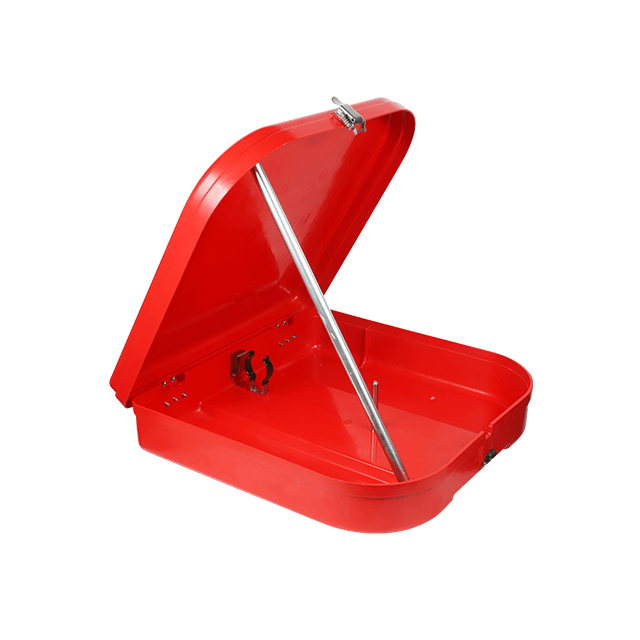
A telecommunications manufacturer requires a durable enclosure for outdoor 5G equipment. They need an electrical junction box capable of surviving severe coastal weather. The initial prototype phase required 50 units. The company now plans to roll out 15,000 units over the next two years.
Open molding cannot meet the rigorous demands of this production scale. The design requires complex internal features. The box needs internal bosses for mounting circuit boards. It requires molded ribs for structural stiffness. Manual lamination cannot consistently form these internal features in a single step.
Furthermore, manual processes produce varying wall thicknesses. You cannot seat a waterproof gasket reliably against an uneven fiberglass edge. This variation compromises the required IP67 and NEMA 4X ratings for water and dust ingress. The manufacturer would face massive warranty claims from flooded electronics.
Transitioning to a compression-molded FRP box solves these engineering bottlenecks instantly. The matched metal tooling ensures absolute precision. It creates the exact wall thickness required. It molds perfectly flat sealing surfaces, ensuring gaskets compress evenly to block moisture.
The process handles complex internal geometry effortlessly. The tool forms mounting ribs directly into the part during the press cycle. Technicians can place threaded brass inserts into the mold before closing the press. The compound flows around the inserts, locking them into the composite permanently. This eliminates secondary drilling and tapping entirely.
Finally, SMC materials formulated for closed molding easily achieve strict UL 94 flammability ratings. This combination of structural rigidity, fire resistance, and zero secondary assembly makes the automated method the only viable choice for heavy-duty industrial applications.
Choosing the right process requires an objective look at your specific project parameters. Use the guidelines below to shortlist your ideal manufacturing method.
Manufacturing Method Decision Matrix
| Decision Criteria | Hand Lay-Up (Open Molding) | Compression Molding (Closed Molding) |
|---|---|---|
| Optimal Volume | Low (1 to 1,000 units) | High (2,000+ units) |
| Initial CapEx (Tooling) | Low (Hundreds to thousands of dollars) | High (Tens to hundreds of thousands of dollars) |
| Per-Unit OpEx (Labor) | High (Extensive manual labor and finishing) | Low (Automated cycles, minimal finishing) |
| Surface Finish Quality | Single-sided (A-side only) | Dual-sided (Class-A on all tool contacts) |
| Tolerance & Repeatability | Low to Moderate (Dependent on operator skill) | Extremely High (Machine-controlled precision) |
| Design Flexibility | High (Easy to modify cheap tooling) | Low (Steel tooling is difficult/costly to alter) |
When reviewing compression molding vs hand lay up across multiple product lines, refer back to this matrix. It keeps procurement and engineering teams aligned on overarching business goals.
The choice between these two distinct composite manufacturing methods is rarely ambiguous once you model the overall production economics. You must look beyond the initial tooling quote. By calculating exact breakeven volumes, analyzing hidden quality costs, and defining precise mechanical requirements, the correct path reveals itself naturally. Open molding serves as an excellent proving ground for prototypes and massive custom structures. However, automated closed molding remains the ultimate destination for scalable, repeatable, and profitable industrial manufacturing.
To move forward successfully, take the following action steps. First, force a strict design freeze within your engineering department. Second, calculate a realistic three-year production volume projection. Finally, consult with an experienced FRP manufacturing partner. Ask them to audit your upfront tooling investment against your projected long-term labor savings. Proper planning ensures you secure the best possible return on your manufacturing investment.
A: Yes, you can achieve a Class-A finish on the tool side. Technicians use high-quality gel coats and perform extensive post-cure buffing. However, this process is highly labor-dependent. It relies entirely on human skill and is not economically scalable for high-volume production.
A: Open molds for manual lay-up usually take 1–2 weeks to fabricate using wood, foam, or basic composites. Conversely, steel matched-metal tooling requires precision CNC machining and heat treatments. This complex process typically commands an 8–12 week lead time before first article inspection.
A: Yes, but it requires a strict Design for Manufacturability (DFM) update. You cannot simply use the exact same CAD file. Engineers must adjust draft angles for proper ejection. They must also optimize wall thicknesses to suit high-pressure material flow and prevent thermal distortion.
