


Views: 0 Author: Site Editor Publish Time: 2026-10-29 Origin: Site


OEM manufacturing of composite parts requires a strict balance between aesthetic requirements, production scalability, and long-term part durability in the field. Selecting the wrong surface finish for molded Fiberglass Reinforced Plastic (FRP) parts results in premature environmental degradation, high rework rates, bottlenecked production lines, and inflated lifecycle expenses. To determine whether to specify gel coat or painted FRP covers, engineering and procurement teams must evaluate tooling quality, production volume, environmental exposure, and specific manufacturing processes. We see parts fail in the field simply because the finish could not handle the operating environment. You need a clear framework to make this specification early in the design phase.
Gel coat provides a highly durable, in-mold chemical bond ideal for high-volume production, but it requires flawless, high-maintenance tooling to prevent surface defects.
Paint systems offer superior color matching, advanced UV resistance, and flexible texture options, making them preferable for complex geometries, custom branding, or lower-volume production runs.
Total cost per part is heavily dictated by the chosen molding process (e.g., fiberglass hand lay-up vs. Resin Transfer Molding) and the subsequent post-processing labor required for surface preparation.
Modern manufacturing often replaces the historical use of gel coat as a paint base with advanced high-build primers and surfacing veils to optimize the final finish.
Environmental compliance and VOC emission limits are increasingly forcing OEMs to evaluate low-VOC epoxy gel coats or specialized high-solids urethane paints.
Baseline requirements dictate the success of any composite part lifecycle. You must evaluate UV stability, abrasion resistance, and chemical exposure based on the actual operating environment. Heavy machinery hoods operating in agricultural settings face constant abrasion from dust and debris, demanding a thick, resilient barrier. Conversely, medical device housings require pristine, easily sanitized surfaces with exact color matching to maintain brand identity. Manufacturers often demand exact Pantone or RAL color codes to align with corporate styling guidelines. Achieving these targets requires careful finish selection right from the drafting table.
You must evaluate specific environmental factors before finalizing the design:
Continuous UV exposure levels and expected gloss retention over a 10-year lifecycle.
Chemical exposure risks, including hydraulic fluids, cleaning solvents, and agricultural fertilizers.
Impact and abrasion risks from flying debris or daily operator interaction.
Thermal cycling extremes that could cause differential expansion between the substrate and the finish.
We must differentiate between structural protection and cosmetic appearance in composite manufacturing. The underlying fiberglass matrix provides mechanical strength and rigidity. The surface finish protects that matrix from environmental degradation, specifically moisture ingress and UV breakdown. It also delivers the required visual appeal. A successful finish performs both functions without failing prematurely under field conditions.
Tooling quality directly dictates the final finish of molded parts. In-mold coatings replicate mold surfaces exactly, magnifying any microscopic mold imperfections. Scratches, dull spots, or uneven wax applications on the mold transfer directly to the finished part. You must analyze the production volume threshold carefully before committing to a specific finish. Investing in Class-A tooling becomes highly cost-effective for high-volume runs where thousands of parts are produced annually. Flawless molds make in-mold application highly efficient, eliminating secondary finishing steps.
Lower volumes often cannot justify massive tooling investments required to maintain a mirror finish. In these scenarios, post-mold painting becomes the logical choice. Paint allows you to use standard tooling, accept minor surface flaws out of the mold, and correct them during the sanding and priming phases. This flexibility keeps initial project costs manageable while still delivering a premium exterior appearance.
Volatile Organic Compound (VOC) limits heavily impact finishing choices across the manufacturing sector. OSHA compliance drives safer facility designs, ventilation requirements, and material handling procedures. Traditional styrene-based polyester systems face intense regulatory pressure due to their high emission profiles during the curing process. High emissions force manufacturers to install expensive air handling systems and regenerative thermal oxidizers to capture off-gassing.
You must evaluate these environmental constraints early in the design phase to avoid costly facility upgrades later. Regulatory bodies continually lower acceptable emission thresholds, forcing OEMs to seek alternative solutions. Many facilities now evaluate low-VOC epoxy systems that offer excellent mechanical properties with a fraction of the emissions. Others transition entirely to specialized high-solids urethane paints to maintain compliance while achieving superior weatherability.
The application process begins before any fiberglass touches the mold surface. Operators spray catalyzed resin directly into a prepared, waxed mold using specialized plural-component spray equipment. They apply this layer evenly across the entire surface, constantly checking wet film thickness to ensure uniformity. The structural laminate is applied only after this initial layer begins to cure and reach a specific tackiness.
A critical chemical cross-linking occurs during this phase. The coating bonds chemically with the composite matrix as the styrene monomer reacts with the polyester or vinyl ester resins in the laminate. This creates a unified, inseparable structure where the finish becomes an integral part of the composite itself. It does not merely sit on top of the substrate like a traditional topcoat. This chemical bond provides exceptional resistance to delamination and blistering.
In-mold application drastically reduces post-processing labor on the factory floor. Parts emerge from the mold with the final finish already applied, requiring only edge trimming and minor flash removal. This eliminates the need for extensive sanding, priming, and multiple trips through a spray booth. Thickness typically ranges from 15 to 25 mils, which is significantly thicker than standard automotive paint.
This robust thickness provides a deep, protective barrier that excels at preventing water intrusion in marine or outdoor applications. It also absorbs minor abrasions without exposing the underlying glass fibers. High-volume manufacturers rely on this efficiency to keep production lines moving rapidly. It minimizes bottlenecks associated with secondary finishing operations and reduces the overall footprint required for the manufacturing facility.
You face strict requirements for high-quality, polished molds when relying on in-mold finishes. Poor tooling leads directly to print-through, where the texture of the fiberglass mat becomes visible on the surface, and general surface dullness. Maintaining these molds requires constant labor and attention from skilled technicians. You must strip, clean, and re-wax molds frequently to prevent styrene buildup and ensure consistent release.
Common defects require expensive manual rework that eats into profit margins. Alligatoring occurs when the coating cures improperly or is applied too thin before lamination, causing the surface to wrinkle. Porosity traps air bubbles near the surface, creating pinholes that collect dirt. Pre-release issues happen when the coating separates from the mold too early, causing distortion. These flaws ruin the aesthetic finish and compromise part durability.
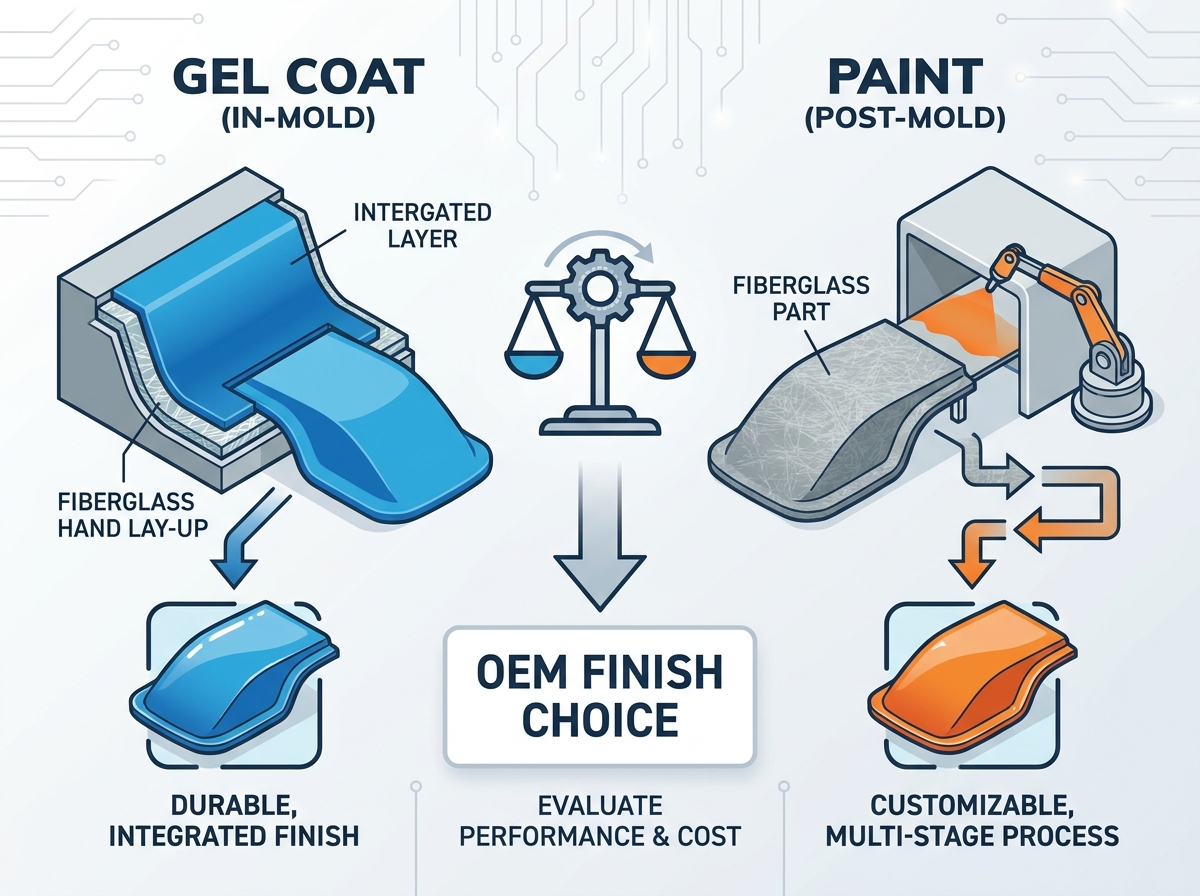
The standard post-mold finishing sequence requires multiple distinct steps executed with precision. Workers demold the raw part, wash away any residual release agents, and begin aggressive surface sanding to create a mechanical profile. They apply specialized high-build primers to fill pinholes, block fiber print-through, and smooth the surface. Finally, they apply the topcoat after the primer is sanded flat.
We differentiate between 1-part and 2-part paint systems based on performance requirements. OEMs typically require 2-part aliphatic polyurethanes for exterior applications. These systems deliver maximum durability, chemical resistance, and gloss retention. Application methods vary based on production scale and part size. Controlled spray booths dominate OEM production environments to ensure clean, dust-free finishes. Paint relies entirely on mechanical adhesion, gripping the sanded profile of the substrate. This differs fundamentally from the chemical bond of in-mold coatings and requires meticulous surface preparation.
Paint offers unparalleled flexibility for custom manufacturing and rapid prototyping. You can offer multiple texture options easily by adjusting spray gun settings or adding texturizing agents to the topcoat. Metallic finishes, pearlescents, and exact color matching become routine processes rather than engineering challenges. You achieve this without altering the base manufacturing process or dedicating specific molds to specific colors.
Paint excels when coating parts with complex geometries. Deep recesses, sharp corners, and negative drafts challenge in-mold spray equipment, often resulting in pooling or thin spots. Achieving uniform in-mold thickness is often difficult on intricate shapes. Paint systems solve this problem entirely. Technicians can manipulate spray guns to cover complex contours evenly, ensuring a consistent, high-quality appearance across the entire part regardless of its shape.
Surface preparation bottlenecks represent the primary manufacturing risk when adopting post-mold finishes. Improper sanding leaves a poor mechanical profile, leading directly to catastrophic adhesion failures in the field. Failing to remove silicone-based mold release agents causes the paint to fish-eye or peel off in sheets. Cleaning protocols must be absolute and uncompromising, often requiring multiple solvent wipes before sanding begins.
Cycle times increase significantly with painted finishes due to the sequential nature of the work. Multiple curing stages delay final assembly. You must wait for primers to flash off, sand them, apply topcoats, and wait for final hardening. This necessitates a controlled paint booth environment with dedicated air makeup units. Managing dust, humidity, and temperature adds complexity to the production floor and requires specialized personnel.
Long-term weathering characteristics differ significantly between the two finishes. Traditional in-mold coatings tend to chalk and oxidize over time when exposed to harsh sunlight. They lose their gloss and require periodic compounding and waxing to maintain their appearance. Automotive-grade clear coats and 2-part urethanes offer superior UV stability. They retain their color and shine for years with minimal maintenance, resisting the chalking effect entirely.
Field repairs require different approaches depending on the finish. Localized repair kits fix minor gouges in thick in-mold coatings easily. Technicians fill the scratch, wet-sand the area, and buff the repair to blend it seamlessly. Extensive paint damage requires a different strategy. You must sand the damaged area, spot-prime, apply base color, and blend the clear coat for full refinishing, which often requires a professional body shop.
In-mold efficiency provides a massive throughput advantage for high-volume operations. Parts finish curing in the mold and are immediately ready for final assembly or shipping. Paint booth processing introduces sequential delays into the workflow, creating potential bottlenecks if the painting capacity does not match molding capacity.
Production scaling impacts your finishing choice directly. Duplicating molds supports rapid scaling for in-mold finishes. This requires capital for new tooling but keeps per-part labor low. Expanding paint facilities supports painted finishes. This requires massive floor space, environmental controls, and permits for increased VOC emissions. You must balance facility constraints against production targets when planning for scale.
You must break down the total lifecycle expenses carefully to make an informed decision. High upfront mold investment pairs with lower per-part labor for in-mold finishes, making it ideal for long production runs. Paint requires lower tooling costs since minor mold flaws are acceptable, but it demands high ongoing finishing labor for sanding and priming.
Compare total material costs accurately across the entire production run. Using a thick in-mold coating as a prep layer for paint is historically inefficient. It adds unnecessary weight and material expense to the part. Modern high-build primers offer superior cost-efficiency. They fill pinholes faster, sand easier, and provide a better substrate for the topcoat. This reduces total labor hours per part and streamlines the finishing department.
Evaluation Criteria | Gel Coat Finish | Painted Finish (2-Part Urethane) |
|---|---|---|
Tooling Requirements | Class-A, highly polished, high maintenance | Standard tooling, minor flaws acceptable |
UV Stability | Moderate; prone to chalking over time | Excellent; retains gloss and color match |
Labor Intensity | Low post-mold labor; high mold prep labor | High post-mold labor (sanding, priming) |
Adhesion Type | Chemical cross-linking (in-mold) | Mechanical adhesion (post-mold) |
Ideal Geometry | Broad, sweeping curves; simple drafts | Complex shapes, deep recesses, sharp corners |
The manual nature of fiberglass hand lay-up introduces inherent material variability into the manufacturing process. Resin-rich areas, inconsistent glass-to-resin ratios, and overlapping fiberglass mats affect the final product's structural and cosmetic properties. These variables complicate the overall FRP surface finish evaluation.
Manufacturers use surfacing veils to enhance smoothness and create a barrier between the coarse structural glass and the outer finish. Applying synthetic or fine glass veils directly behind the outer layer blocks fiber print-through effectively. The veil acts as a buffer zone, absorbing resin shrinkage during the curing phase. Thick initial coatings or high-build primers further mitigate print-through risks. They hide the coarse texture of heavy woven roving or chopped strand mat used extensively in open-mold processes.
Resin Transfer Molding (RTM) parts are frequently painted rather than receiving in-mold finishes. The closed-mold injection process creates unique surface dynamics that challenge traditional coatings. Standard in-mold coatings often wash away or distort during high-pressure resin injection, leading to bare spots and rejected parts.
To solve this, manufacturers use specialized in-mold primers designed specifically for closed-mold applications. These primers withstand the injection wash without moving. They bond chemically with the injected resin as it cures under pressure. More importantly, they accept post-mold paint systems perfectly once the part is demolded. This ensures superior topcoat adhesion on RTM-molded parts. It streamlines the painting process by eliminating heavy sanding steps, requiring only a light scuff before the topcoat is applied.
Switching to paint requires a strict operational framework to prevent field failures. You must select compatible primers designed specifically for composite substrates, avoiding standard automotive primers that may lack the necessary flexibility. Establish strict surface preparation standard operating procedures for the finishing department. Train workers to remove all mold release agents thoroughly using dedicated wax and grease removers. Conduct cross-hatch adhesion testing on every initial production batch to verify mechanical bonding.
Implement this standard operating procedure for surface preparation:
Wash the raw part with a dedicated wax and grease remover to dissolve mold release agents.
Scuff the entire surface with 80-grit to 120-grit sandpaper to create a mechanical profile.
Blow off all dust using clean, dry, oil-free compressed air.
Apply a high-build epoxy or urethane primer to fill microscopic pinholes.
Block-sand the primer flat before applying the final topcoat.
Address the historical OEM practice of using thick in-mold coatings as a primer. Transitioning to modern, purpose-built primers eliminates unnecessary weight from the final assembly. It also reduces material waste and lowers emissions on the molding floor. Removing silicone-based mold release agents entirely from the facility prevents catastrophic paint delamination and fish-eye defects.
Evaluate the transition from traditional polyester systems to low-VOC epoxy alternatives to future-proof your manufacturing operations. Epoxy offers higher mechanical strength, better water resistance, and significantly lower emissions. However, you must discuss the trade-offs in cure times and processing requirements.
Epoxy systems often require heat to cure efficiently and reach full mechanical properties. This impacts tooling compatibility directly. Standard fiberglass molds built with polyester tooling resins may distort under elevated curing temperatures. Adopting environmentally compliant finishing systems requires holistic facility planning. You must balance emission targets against production throughput, tooling longevity, and capital equipment investments.
To finalize your surface finish specification and ensure long-term part performance, execute the following steps:
Request sample plaques of both finishes from your manufacturing partners to conduct internal cross-hatch adhesion and accelerated weathering tests.
Audit your current tooling inventory to determine if existing molds possess the Class-A surface required for in-mold coatings without extensive rework.
Calculate your break-even production volume to decide if high upfront tooling investments outweigh the ongoing labor expenses of post-mold painting.
Implement strict surface preparation standard operating procedures if transitioning to paint, focusing heavily on the complete removal of silicone-based mold release agents.
A: Yes. While gel coat was historically used as a prep layer, modern OEMs use specialized high-build primers after thorough surface sanding and removal of all mold release agents.
A: Gel coat is thicker and better resists deep scratches, but 2-part urethane paint offers superior UV resistance and prevents chalking over time.
A: Hand lay-up introduces variability and potential print-through, often requiring surfacing veils, a thick gel coat, or extensive sanding and priming before paint.
A: Yes, epoxy gel coats offer lower VOCs and higher mechanical strength, but they require different tooling prep and have different UV stability characteristics.
A: Gel coat has higher upfront tooling costs but lower per-part labor. Paint has lower tooling requirements but significantly higher per-part labor and facility costs.
A: Minor gel coat scratches can be fixed with localized repair kits, wet-sanded, and buffed out. Painted surfaces require sanding, spot-priming, and color blending to repair.
A: An in-mold primer is sprayed into the mold like a gel coat but is formulated specifically to bond chemically with the FRP and mechanically with post-mold paint, reducing surface prep time.
