


Views: 0 Author: Site Editor Publish Time: 2026-10-01 Origin: Site


Designing commercial spaces often creates a clash between grand design visions and tight project realities. You want stunning botanical displays to elevate the space. However, project budgets and rigid timelines usually push back hard. Finding the right balance requires a highly strategic approach to material sourcing.
Standard commercial planters easily fit about 80% of landscaping projects perfectly. They arrive quickly and keep costs predictable. But the remaining 20% of applications often dictate the overall success of the project. These complex installations determine structural integrity and long-term ROI. A failed planter can cause massive property damage.
How do you know when standard options simply will not work? We built this objective evaluation framework to guide your next project. Architects, developers, and landscape professionals will learn exactly how to assess their site needs. You will discover whether the premium for custom fabrication is truly justified.
Cost vs. Value: Customization introduces tooling costs and longer lead times but prevents costly structural retrofits or design compromises.
Structural Imperatives: Custom specs are non-negotiable for high-load applications, such as large tree containment on weight-restricted rooftops.
Supplier Vetting: Not every manufacturer can handle custom orders; verifying a fiberglass planters supplier requires auditing their mold-making, finishing, and warranty processes.
Specification Accuracy: Exact fiberglass planters specifications (wall thickness, internal bracing, marine-grade gel coats) dictate the lifespan of a custom unit.
You must start every landscaping project by establishing a clear baseline assumption. Off-the-shelf commercial fiberglass planters offer immediate availability. They also provide fixed pricing models. This makes them ideal for fast-tracked construction phases. They work exceptionally well for budget-capped projects where basic shrubbery containment is the only goal. You select a size, pick a standard color, and schedule delivery.
However, you must carefully analyze the tipping point for customization. This tipping point occurs when standard options fail to meet site-specific demands. Buyers often look strictly at the upfront tooling costs of custom molds. They view this as an unnecessary expense. They fail to compare this premium against the hidden costs of modifying standard units on-site. Field modifications frequently compromise structural integrity. They ruin factory finishes. They also immediately void manufacturer warranties. A custom mold prevents these expensive downstream failures.
To justify customization, you must define strict success criteria for your project. A successful custom order must achieve specific benchmarks to deliver true value.
Exact Dimensional Tolerance: The units must fit perfectly within predefined architectural alcoves.
Seamless Architectural Integration: The design language must match the surrounding hardscaping exactly.
Verified Load-Bearing Capacity: The containers must safely hold saturated soil and mature root balls without bowing.
Utility Accommodation: The design must allow seamless integration for necessary plumbing and lighting.
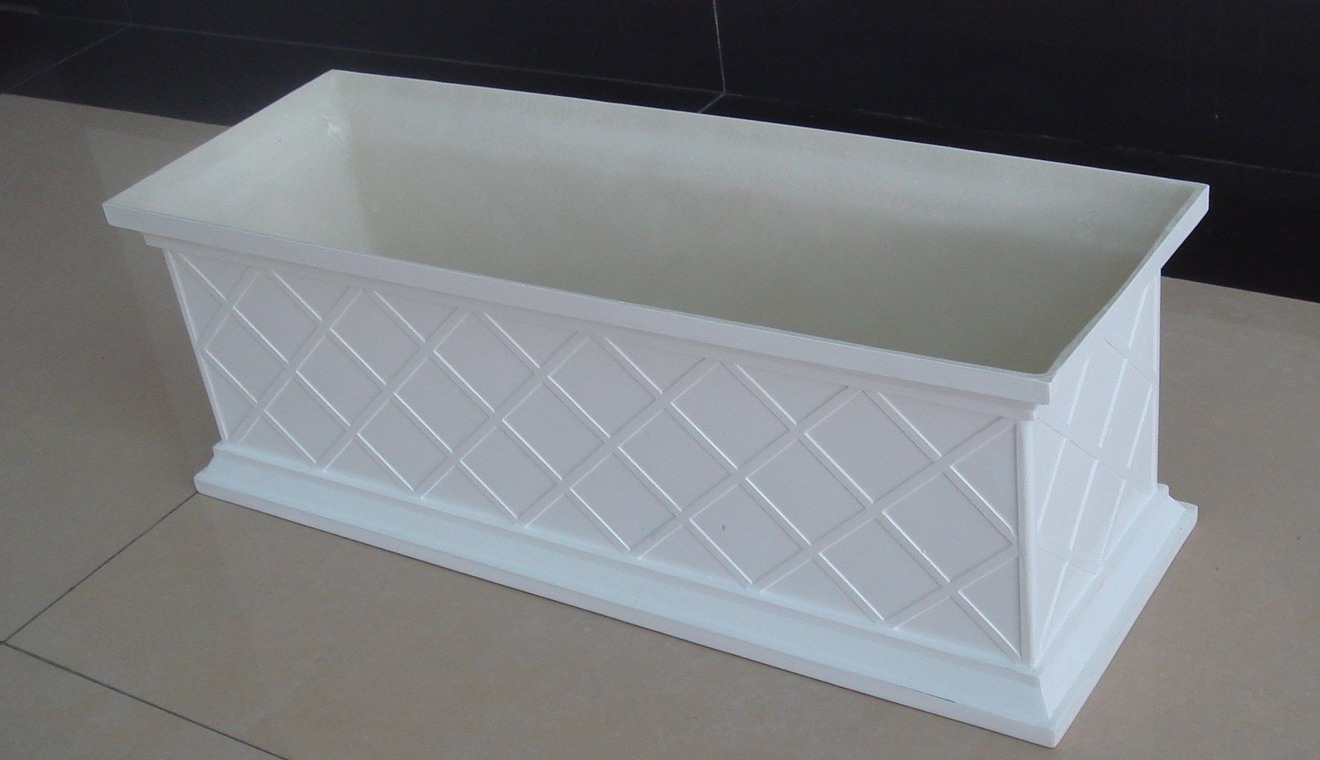
Certain landscaping challenges make standard off-the-shelf products entirely obsolete. Attempting to force standard shapes into complex spaces always leads to poor aesthetic results. It also creates long-term structural risks. Custom fabrication becomes an absolute necessity in the following four scenarios.
Architectural and Spatial Constraints: Modern architecture rarely relies solely on straight lines and perfect right angles. You often need to design for curved retaining walls or meandering pathways. Sloped gradients and highly specific alcoves demand exact measurements. Off-the-shelf dimensions leave unacceptable gaps in these spaces. Custom molds allow you to follow exact spatial radii. This creates a built-in, permanent look.
Advanced Root Containment & Weight Limits: Structural slabs and green roofs have strict weight limitations. Managing high-volume soil and aggressive root systems requires engineering. For example, specifying a large box white for trees fiberglass planters requires custom internal cross-bracing. Engineers must add false bottoms to these units. False bottoms drastically reduce heavy soil volume while accommodating the tree. This prevents lateral bowing and protects the structural slab beneath.
Brand Identity and Aesthetic Compliance: High-end retail spaces and corporate headquarters require strict visual compliance. You must move beyond standard RAL colors. Custom fabrication allows precise pantone matching to align with corporate branding. You can also specify specialized textures. Manufacturers can replicate faux concrete, weathered corten steel, or metallic finishes. They can even emboss corporate logos directly into the fiberglass mold.
Integrated Technology & Utility Hiding: Modern landscape designs incorporate heavy technology. You cannot leave ugly utility lines exposed. Custom fabrication allows precise cutouts during the manufacturing process. You can request pre-cut housings for LED lighting strips. You can integrate self-watering reservoirs perfectly. Factories can build hidden channels for irrigation lines. They can also engineer recessed bases to hide heavy-duty caster wheels.
Customization means nothing if the underlying engineering remains weak. You must clearly define the technical requirements before production begins. These specific material choices dictate how long the product will survive in commercial environments.
First, evaluate wall thickness and reinforcement. Standard commercial planters typically use 2-3mm fiberglass. This handles basic potting soil well. Custom applications, however, often handle massive soil volumes. Wet soil creates immense lateral pressure. You often require 4-6mm thickness for large installations. Manufacturers must also add reinforced corners and internal bracing. This prevents the fiberglass from bowing or cracking outward.
Next, you must specify resin and finish quality. Standard polyester resins work for mild, indoor climates. Marine-grade epoxy resins are crucial for harsh environments. Coastal installations face constant salt spray. High-UV environments degrade basic gel coats quickly. Upgrading to automotive-grade polyurethane paints ensures the color will not chalk or fade.
You must also engineer custom drainage and waterproofing variables. Standard drainage holes rarely align with complex site plumbing. You must engineer custom drainage patterns based on local rainfall data. Slope gradients and specific botanical needs also dictate hole placement. Some units require complete waterproofing for indoor use.
Finally, focus on tolerance management. Large modular installations require multiple units to sit flush against one another. You must establish acceptable millimeter variances in the manufacturing contract. If the variance is too loose, the installation will look disjointed and sloppy.
Table 1: Standard vs. Custom Planter Specifications
Specification Element | Standard Commercial Grade | Custom Engineered Grade |
|---|---|---|
Wall Thickness | 2 - 3 mm | 4 - 6 mm (Load dependent) |
Internal Reinforcement | None or minimal | Cross-bracing and false bottoms |
Resin Type | Standard Polyester | Marine-grade Epoxy |
Color Matching | Limited standard palette | Exact Pantone / Faux Textures |
Dimensional Tolerance | +/- 0.5 inches | +/- 2 millimeters |
Moving from a design concept to a finished custom product requires patience. You must understand the manufacturing phases to manage client expectations effectively. Custom fabrication fundamentally alters project timelines and logistics.
The prototyping phase sets the foundation for success. Factory technicians carve master plugs from wood or high-density foam. They then cast the initial fiberglass mold over this plug. Explain this mold-creation process to your stakeholders. This tooling requires a significant upfront investment. Tooling costs heavily impact the unit economics of small-batch orders. Ordering one custom unit is expensive. Ordering fifty units spreads the tooling cost out effectively.
Production and shipping timelines also require careful planning. Custom fabrication typically adds 8 to 14 weeks to your schedule. Factories must build the mold, cast the resin, and allow proper curing time. Shipping presents another major logistical reality. Large, custom shapes are often non-nestable. They take up massive amounts of space on freight trucks. You must budget accordingly for higher freight costs.
Risk mitigation separates successful projects from failures. Improper curing leads to brittle walls. Cheap paints lead to severe color-fading. Weak walls lead to structural bowing. You must write contracts that hold manufacturers fully accountable to structural guarantees. Demand specific language covering lateral pressure limits.
Approving designs without requesting 3D CAD files first.
Failing to calculate freight dimensions into the final budget.
Ignoring local climate factors when choosing the final gel coat.
Forgetting to specify access panels for future plumbing maintenance.
Finding a factory to build a box is easy. Finding a specialized engineering partner is difficult. You must thoroughly vet potential manufacturing partners before signing purchase orders. A beautiful design on paper means nothing if the factory lacks execution capabilities.
First, audit their manufacturing capabilities. Do they outsource mold-making to third parties, or do they handle it in-house? In-house tooling ensures much tighter quality control. It also allows for significantly faster prototyping. Outsourced tooling often causes massive delays if revisions are necessary.
Second, demand robust engineering support. A credible supplier acts as a technical partner. They should provide detailed CAD drawings. They should offer accurate 3D renderings. They must also provide structural recommendations before any deposit is paid. If a supplier only relies on rough sketches, find a new partner.
Third, verify warranty and compliance standards. Look for highly transparent warranty terms. You ideally want 3 to 5 years of coverage for commercial use. The warranty must explicitly cover custom structural modifications. It should also protect against premature finish degradation and UV fading.
Finally, always require proof of performance. Request detailed case studies. Ask for reference projects that specifically highlight custom installations. Ensure these past projects exist in similar climates or use cases. A supplier accustomed to indoor mall projects might fail at engineering a rooftop planter for a snowy climate.
Interview the lead engineer, not just the sales representative.
Request physical material samples of the exact resin and paint combination.
Review the supplier's claim resolution history for past structural failures.
Ensure the factory conducts internal load testing before shipping.
Custom fiberglass planters represent a highly engineered solution, not just a simple aesthetic upgrade. When standard options compromise your structural requirements or design vision, customization becomes the only logical path forward. By prioritizing exact specifications, robust reinforcements, and superior resins, you guarantee a flawless installation. These containers must safely hold massive soil weights, withstand harsh climates, and integrate seamlessly into complex architecture.
Your next step is to perform a rigorous audit of your site plans. Calculate your hard spatial constraints and maximum weight allowances carefully. Once you establish these parameters, contact shortlisted manufacturers immediately. Request technical CAD assessments from their engineering teams. This proactive approach will help you determine exact project feasibility, lock in accurate pricing, and ensure your vision becomes a durable reality.
A: Custom molds require significant upfront tooling costs. Because of this, single-unit orders are usually prohibitively expensive. Most reputable manufacturers require a minimum order quantity of 10 to 20 units to spread out the tooling fees. Larger volumes drastically reduce the price per unit.
A: You can expect to pay 30% to 60% more for custom units compared to standard off-the-shelf equivalents. This premium covers the initial mold creation, engineering time, specialized cross-bracing, and upgraded marine-grade materials needed for the project.
A: Yes. High-end manufacturers use automotive-grade polyurethane painting processes. They can precisely match any RAL or Pantone color code. They can also utilize specialized gel-coats and aggregates to replicate the exact texture of concrete, stone, or rusted corten steel.
A: The entire process typically takes between 8 and 14 weeks. This transparent timeline includes CAD drafting, client approvals, master mold building, fiberglass casting, proper resin curing, and final freight transit. Complex shapes or large volumes may push timelines closer to 16 weeks.
