


Views: 0 Author: Site Editor Publish Time: 2026-09-05 Origin: Site


Rusted metal cabinets and cracked plastic alternatives create severe compliance risks in harsh commercial, industrial, or marine environments. Facility managers often deal with constant replacement cycles when deploying standard materials. Standard steel corrodes quickly near saltwater. Basic plastics degrade and shatter after prolonged sun exposure.
However, you must understand that not all fiberglass is equal. A cabinet’s functional lifespan depends entirely on its specific resin formulation, gel coat quality, and manufacturing standards. Choosing the wrong composite grade leaves life-saving equipment vulnerable to the elements.
We built this guide to provide facility managers, safety engineers, and contractors with a strict, evidence-based framework. You will learn how to accurately evaluate material grades and navigate complex compliance requirements. We also explain how to vet suppliers properly before you finalize specifications or authorize a bulk purchase.
Environmental degradation aggressively targets safety equipment. When you install standard steel cabinets in coastal regions or chemical processing plants, they rarely survive past a three-to-five-year replacement cycle. Salt spray, humidity, and atmospheric chemicals quickly compromise painted metal. Once the surface scratches, galvanic corrosion takes hold. Rust sets in, weakening the hinges and compromising the door seal.
Inferior plastics offer no viable alternative. Standard polycarbonate or basic PVC units become brittle under continuous ultraviolet (UV) exposure. They lose their structural integrity and often shatter upon impact. You cannot rely on these materials to protect heavy fire extinguishers during an emergency.
Instead, upgrading to a high-grade fiberglass housing for fire extinguisher changes the longevity equation. Premium fiberglass composites routinely deliver a 15-to-20-year functional lifespan. They resist salt, moisture, and chemical vapors naturally.
A successful deployment hinges on very specific success criteria. First, the unit must maintain continuous high visibility without fading. Second, it must guarantee zero water ingress to protect the pressurized cylinder inside. Third, it must provide unimpeded access during an emergency. Facility teams should never have to perform annual painting, rust mitigation, or hinge lubrication just to keep a cabinet functional.
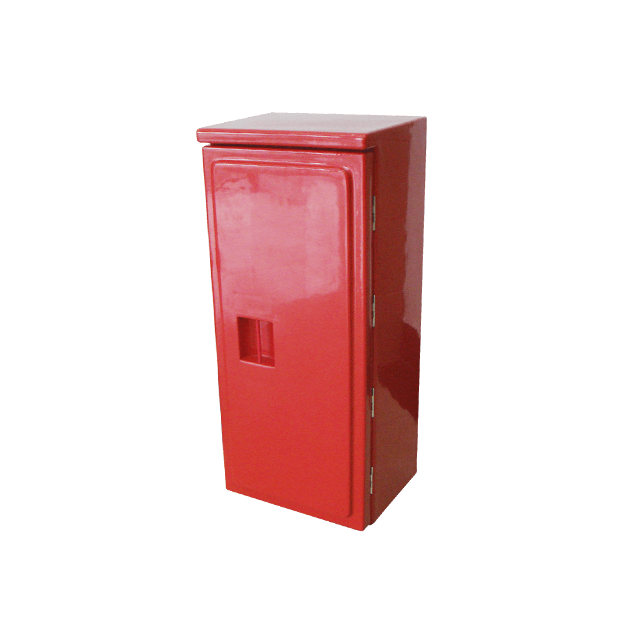
The foundation of any fiberglass enclosure is its resin system. The resin binds the glass fibers together and dictates the environmental resistance of the final product. We classify these resins into three core grades.
Orthophthalic Polyester Resin (General Purpose)
Manufacturers commonly use orthophthalic resin for standard outdoor applications. It provides a baseline, cost-effective option for mild environments. However, we do not recommend it for extreme industrial use. It remains vulnerable to prolonged chemical exposure and heavy moisture saturation over time.
Isophthalic Polyester Resin (Industrial Standard)
Isophthalic resin serves as the recommended baseline for marine and heavy commercial applications. It features a denser molecular structure. This provides superior water resistance, higher tensile strength, and excellent corrosion resistance. If you install units near the ocean or in demanding commercial facilities, isophthalic resin delivers necessary durability.
Vinyl Ester Resin (Extreme Environments)
Vinyl ester represents the highest grade available. It incorporates an epoxy backbone, providing maximum resistance to aggressive corrosive agents and thermal shock. We specify vinyl ester exclusively for chemical processing plants, wastewater treatment facilities, and offshore oil rigs.
The Role of Gel Coats & UV Inhibitors
The underlying resin provides strength, but the outer layer dictates survival. Without a high-quality, UV-resistant gel coat, exposed fiberglass undergoes "chalking." The surface breaks down, exposing raw glass fibers that splinter. A premium gel coat acts as a heavy-duty sunscreen. It maintains the crucial "Hi-Vis Red" pigment and seals the composite against micro-abrasions.
Resin Grade Comparison for Fire Safety Cabinets
| Resin Type | Primary Application | Water Resistance | Chemical Resistance |
|---|---|---|---|
| Orthophthalic | Standard Outdoor / Mild Weather | Moderate | Low |
| Isophthalic | Marine / Coastal / Industrial | High | Moderate to High |
| Vinyl Ester | Offshore Rigs / Chemical Plants | Maximum | Maximum |
Even the strongest fiberglass tub fails if the attached components are weak. You must scrutinize the technical details before finalizing your order. Reviewing exact fiberglass fire extinguisher cabinets specifications prevents operational failures in the field.
Selecting the right materials solves the environmental challenge. Next, you must address physical installation codes and building compliance. A perfectly built cabinet still fails inspection if mounted incorrectly.
Procuring reliable safety enclosures requires strict vendor qualification. You cannot rely on marketing brochures. Evaluating a fiberglass fire extinguisher cabinets supplier means demanding verifiable engineering data.
Demand manufacturing transparency. Request official Technical Data Sheets (TDS) proving the exact resin types used. Ask for the measured thickness of the gel coat. Reject any generic claims that simply state "made of fiberglass." You need precise chemical profiles.
Look for suppliers who provide verifiable third-party testing. High-quality enclosures undergo rigorous environmental trials. Ask for reports covering salt spray resistance (ASTM B117), accelerated UV exposure (ASTM G154), and flammability ratings (UL or ASTM standards). These documents prove the material performs exactly as promised.
Examine the warranty realities closely. A trustworthy manufacturer offers a multi-year warranty guarding against structural failure and severe color fading. However, they will transparently exclude intentional vandalism or blunt-force vehicle impacts. Read the fine print to understand what environmental conditions the warranty actually covers.
Finally, assess their supply chain and lead times. Large contractor projects require strict scheduling. Evaluate whether the supplier can fulfill bulk orders for custom-sized or specifically colored units. Delays in receiving life-safety equipment will halt building occupancy permits and delay major construction milestones.
Standard metals and plastics routinely fail when exposed to harsh industrial or coastal environments. Upgrading to specialized composites eliminates these continuous replacement cycles. For 90% of severe environments, an isophthalic resin formulation paired with a UV-resistant gel coat and 316L stainless hardware offers the best long-term reliability.
Selecting the right fiberglass fire extinguisher cabinets ensures high visibility and rapid access during emergencies. Your next step is to audit your facility immediately. Identify your primary environmental risks, including chemical exposure, salt spray, UV intensity, and physical impact zones. Once you map these hazards, contact shortlisted suppliers and request their technical data sheets based on the strict specifications outlined above.
A: Premium fiberglass enclosures typically last 15 to 20 years outdoors. Their exact lifespan depends heavily on the gel-coat quality and the intensity of daily UV exposure. Regular cleaning extends this timeframe significantly.
A: Yes, but you must clarify the difference between the cabinet material and the installation method. Standard fiberglass does not provide fire resistance. You require specifically designed fire-rated tubs or approved intumescent fire-stopping materials for recessed installations.
A: The fiberglass material itself is completely impermeable. However, the door seal dictates overall water resistance. You must look for enclosures featuring structural EPDM gaskets and secure latches to ensure total waterproof performance.
A: Yes, you can repaint them using specific marine-grade or epoxy paints. However, purchasing units with high-quality, UV-inhibiting gel coats should completely eliminate the need for repainting for a decade or more.
